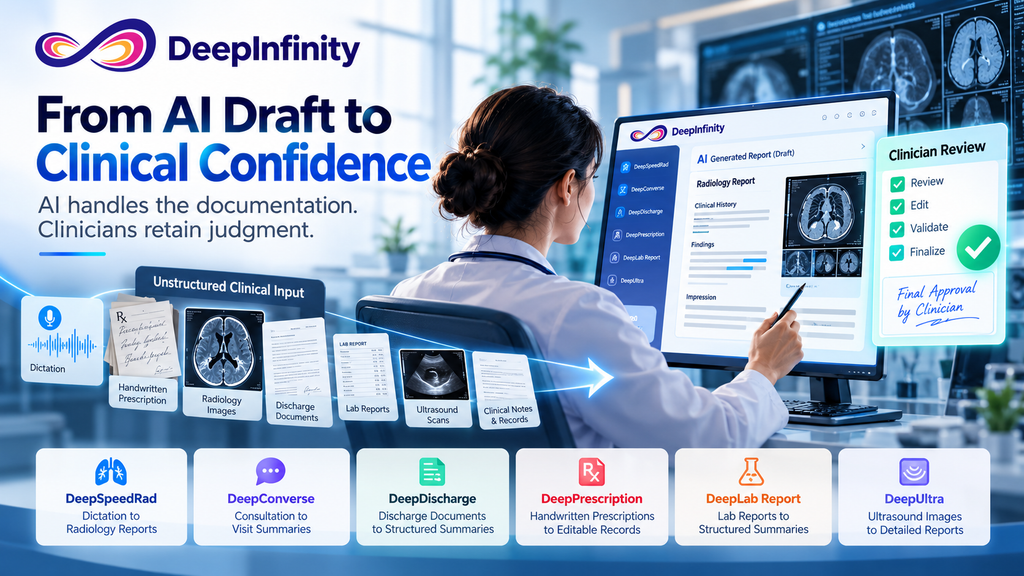
Healthcare documentation is essential—but it should not become the reason clinicians spend less time on patient care.
Every day, healthcare teams manage consultations, radiology findings, ultrasound reports, laboratory documents, prescriptions, discharge records, ICU data, and emergency triage information. Much of this information begins as speech, handwritten text, scanned files, images, or fragmented records.
The challenge is not simply creating documents.
The challenge is turning clinical information into clear, structured, usable documentation—quickly, accurately, and in a way that fits existing hospital workflows.
That is where DeepInfinity helps.
DeepInfinity uses AI to support clinical documentation and workflow automation across radiology, OPD, ICU, emergency care, laboratories, discharge processes, prescriptions, and patient registration. Its tools help transform unstructured input into structured drafts that clinicians can review, edit, and finalize.
AI Assistance, Not AI Replacement
The most effective clinical AI does not attempt to remove clinicians from the decision-making process.
Instead, it handles the repetitive work around documentation:
- Capturing spoken findings and conversations
- Converting speech into text
- Structuring reports using standard templates
- Summarizing uploaded clinical documents
- Extracting details from prescriptions
- Preparing discharge summaries
- Organising patient information into clinically familiar formats
The clinician remains central to the workflow.
They provide the findings, review the AI-generated output, correct details where necessary, add clinical context, and make the final decision. This approach preserves professional accountability while reducing the time spent on repetitive documentation.
One Platform, Multiple Workflows
DeepInfinity supports multiple documentation scenarios through specialised tools.
1. From Dictation to Radiology Report
With DeepSpeedRad, clinicians can dictate or type radiology findings, choose a preferred template and language, and generate a structured report. The workflow is designed to help radiologists reduce typing effort while retaining full control over the final report.
Instead of starting every report from a blank page, the radiologist starts with their findings and lets AI assist with structure, format, and speed.
2. From Consultation to Visit Summary
With DeepConverse, clinicians can select a language, begin a conversation, view live transcription, and submit the discussion for summarization. The platform then produces a detailed visit summary that can be reviewed, edited, saved, or downloaded.
This supports a more natural consultation experience. Clinicians can focus on listening and engaging with patients rather than trying to document every point in real time.
3. From Discharge Documents to Structured Summaries
Discharge documentation often involves reviewing multiple pages of clinical information. DeepDischarge allows users to upload discharge documents in JPG, PNG, or PDF formats, generate a structured discharge summary, edit the generated content, and then save or download the final version.
The objective is not to automate away clinical review. It is to give clinicians a high-quality starting point.
4. From Handwritten Prescriptions to Editable Records
Handwritten prescriptions can be difficult to interpret, store, and share. DeepPrescription extracts prescription details from uploaded files, after which the user can review and make necessary edits before saving or exporting the document.
This is a practical example of responsible automation: the AI speeds up extraction, while the professional validates the final record.
5. From Unstructured Reports to Usable Summaries
DeepInfinity also supports ultrasound report generation through DeepUltra, lab report summarization through DeepLab Report, and audio-to-text conversion through Deep Convert Audio. Across each workflow, the platform helps bring structure to unstructured information.
The Role of Clinician Review
In healthcare, an AI-generated output should be treated as a clinical draft, not an unquestioned final answer.
A safe and practical workflow looks like this:
| Step | DeepInfinity’s Role | Clinician’s Role |
| Input Capture | Captures dictation, audio, images, scans, or uploaded documents | Provides findings, context, and relevant source information |
| AI Processing | Transcribes, extracts, summarizes, structures, or formats content | Evaluates whether the output reflects the actual clinical scenario |
| Draft Generation | Produces a report, note, summary, or structured document | Reviews the draft for accuracy, completeness, and relevance |
| Editing | Provides editable outputs and configurable templates | Corrects, adds, or removes information as needed |
| Finalization | Supports saving, downloading, sharing, or integration | Approves the final clinical documentation and retains accountability |
This model is reflected in DeepInfinity’s product flows. The platform’s pathology reporting workflow includes “Review Final Approval,” while its ICU and emergency documentation examples state that generated scores and insights are decision support and do not replace clinical judgment.
Configurable AI Fits Real Hospitals
No two hospitals document care in exactly the same way.
That is why customization matters. The DeepInfinity Web App enables users to manage templates, upload templates and macros, add custom medical vocabulary, configure language, adjust report appearance, and control settings such as speech-processing models and noise suppression.
This means AI does not have to force clinicians into a generic format. Instead, it can work within institutional reporting standards and documentation preferences.
DeepInfinity also describes integrations with EHR, HIMS, PACS, RIS, MS Word, OpenOffice, CKEditor, and other hospital documentation systems—helping structured information move through the clinical environment rather than remaining isolated in a separate tool.
Better Workflow, Stronger Clinical Focus
The purpose of clinical AI is not simply to generate text faster.
It is to help hospitals create a better workflow:
- Less repetitive typing
- Faster report preparation
- More standardized documentation
- Easier review of complex records
- Improved continuity of information across systems
- More time for clinical reasoning and patient interaction
DeepInfinity’s approach brings together voice AI, document intelligence, imaging workflows, structured reporting, and hospital-system integration. Yet the clinician remains the final reviewer and decision-maker.
That is the right balance for healthcare AI.
Conclusion
The future of clinical documentation is not about replacing healthcare professionals with automation.
It is about giving them better tools.
DeepInfinity helps transform raw clinical input into structured, editable, and workflow-ready documentation. But clinical confidence comes from the human layer: the clinician who reviews the output, applies context, validates the details, and makes the final decision.
AI can prepare the draft. Clinicians provide the confidence.
Leave a Reply